
EKPHRASIS
The poem that looks at a painting

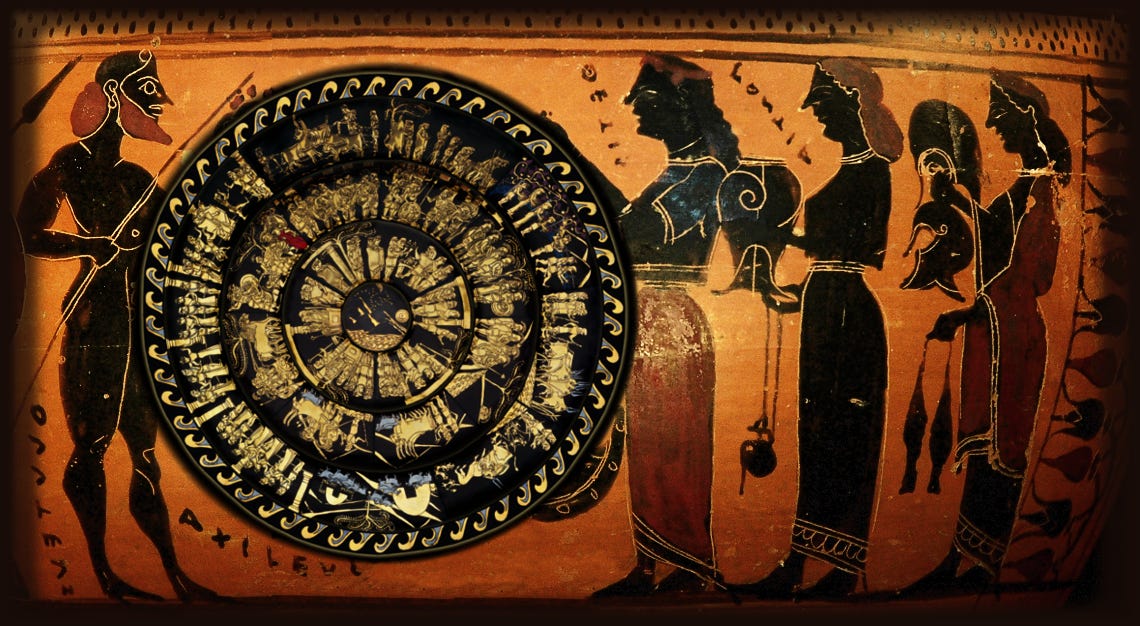
image from https://theshieldofachilles.net/
Consider what Homer saw.
In the eighteenth book of the Iliad, Hephaestus forges a shield for Achilles where Homer describes it for one hundred and thirty lines: the earth and sky and sea, two cities at peace and at war, a wedding and a murder trial, the harvest and the dance, and the great river of Ocean running around the rim. The shield holds the cosmos in bronze. It is the most famous object in Greek literature, yet it does not exist (spoiler). The shield is forged in fire by a god, given to a hero who will die, described by a blind poet, and known to us only in a poem. The first work of ekphrasis in the Western tradition is also the proof that poetry can summon visual art out of language alone.
Ekphrasis comes from the Greek for “speaking out,” a rhetorical term that meant vivid description. It encouraged the kind of writing that manifests an image before the eyes. Over time the word narrowed down to a specific poetic mode: the poem that takes a work of visual art as its subject. Standing before a work of art produces a particular kind of perspective on language, and the poem is the form that perspective takes.
The first actionable-theory of ekphrasis comes from someone who actually practiced it. In the third century, Philostratus the Elder wrote a book of Eikones, descriptions of sixty-five paintings he claimed to have seen in a gallery at Naples. His preface argues that “poets and painters make equal contribution” to our knowledge of the world. The two arts pursue the same truth by different means, and the writer who stands before a painting and gives it a voice is doing work that is neither subordinate to the painter nor in competition with him.
In 1766 Gotthold Ephraim Lessing tried to police the border between the two arts. In his work, Laocoön, he argued that painting belongs to space and poetry to time. On one hand, the painter can show all parts of the body simultaneously, while the poet must unfold the body in sequence. Each medium has its proper subject and its proper limits.
Because the painter is confined to a single arrested instant, Lessing argued, the choice of moment matters absolutely. “The most fruitful moment and the most fruitful aspect of that moment must be chosen,” he writes. “Now that only is fruitful which allows free play to the imagination.” The painter has already chosen the fruitful moment, and then the ekphrastic poem is what happens in the free play that choice has opened up.
Lessing tested the principle on the sculpture itself. “When Laocoon sighs,” he wrote, “imagination can hear him cry; but if he cry, imagination can neither mount a step higher, nor fall a step lower.” What he is saying is that in artwork, the art declares the scene and there is no room for the imagination. However, in poetry the imagination is a necessary element. As Wallace Stevens championed: “It is the imagination pressing back against the pressure of reality. It seems, in the last analysis, to have something to do with our self-preservation; and that, no doubt, is why the expression of it, the sound of its words, helps us to live our lives.”
Ekphrasis writes into the room Lessing has described. The painting has framed a moment without pronouncing what surrounds it. The poem gives back the words the silent figures were never given: the cost of the gesture, the conversation we did not hear in the gallery. It is the art of putting time back into the still frame.
The poem:
Ode on a Grecian Urn
By John Keats

Thou still unravish'd bride of quietness,
       Thou foster-child of silence and slow time,
Sylvan historian, who canst thus express
       A flowery tale more sweetly than our rhyme:
What leaf-fring'd legend haunts about thy shape
       Of deities or mortals, or of both,
               In Tempe or the dales of Arcady?
       What men or gods are these? What maidens loth?
What mad pursuit? What struggle to escape?
               What pipes and timbrels? What wild ecstasy?...
O Attic shape! Fair attitude! with brede
         Of marble men and maidens overwrought,
With forest branches and the trodden weed;
         Thou, silent form, dost tease us out of thought
As doth eternity: Cold Pastoral!
         When old age shall this generation waste,
                Thou shalt remain, in midst of other woe
Than ours, a friend to man, to whom thou say'st,
         "Beauty is truth, truth beauty,—that is all
                Ye know on earth, and all ye need to know."
The ekphrasis: Keats does not describe the urn so much as interrogate it. He addresses it directly as “thou still unravish’d bride of quietness,” and the poem becomes a conversation in which only one party can speak. The figures on the urn are caught at the threshold of consummation, the lover always about to kiss, the piper always about to play, the trees always about to lose their leaves, the heifer always about to be sacrificed. Keats finds the truth the urn could not pronounce, that arrest is not death but a stranger immortality, that the unfulfilled gesture has its own kind of fulfillment, that beauty held still is also a kind of grief, that the eternal moment is purchased at the cost of consummation. The urn finally answers him in the closing couplet, but the answer is famously contested, and rightly so. Ekphrasis at its highest does not resolve into the painting’s voice. It leaves the poet and the silent object in unresolved conversation, and trusts the reader to carry it forward.
The poem:
Musée des Beaux Arts
By W. H. Auden

About suffering they were never wrong,
The Old Masters: how well they understood
Its human position; how it takes place
While someone else is eating or opening a window or just walking dully along

How, when the aged are reverently, passionately waiting
For the miraculous birth, there always must be
Children who did not specially want it to happen, skating
On a pond at the edge of the wood:
They never forgot
That even the dreadful martyrdom must run its course
Anyhow in a corner, some untidy spot
Where the dogs go on with their doggy life and the torturer's horse
Scratches its innocent behind on a tree.

In Brueghel's Icarus, for instance: how everything turns away
Quite leisurely from the disaster; the ploughman may
Have heard the splash, the forsaken cry,
But for him it was not an important failure; the sun shone
As it had to on the white legs disappearing into the green
Water; and the expensive delicate ship that must have seen
Something amazing, a boy falling out of the sky,
Had somewhere to get to and sailed calmly on.
The ekphrasis: Auden walks into a museum and writes the poem of the museum-goer, the modern figure who notices what the masterpieces have in common. He praises the Old Masters for what they understood about suffering, the way it never happens at the center of the canvas. The poem traces what surrounds the agony in painting after painting: someone finishing a meal, someone opening a window, an animal carrying on with its animal life, the torturer’s horse leaning patient against a tree. By the time Auden arrives at Brueghel’s fall of Icarus, the truth is already in place. The world looks the other way. The catastrophe is small inside the larger scene of ordinary life. Auden does not describe the painting in detail. He describes what the painting knows.
The poem:
Poem
by Elizabeth Bishop

About the size of an old-style dollar bill,
American or Canadian,
mostly the same whites, gray greens, and steel grays
—this little painting (a sketch for a larger one?)
has never earned any money in its life.
Useless and free, it has spent seventy years
as a minor family relic
handed along collaterally to owners
who looked at it sometimes, or didn’t bother to.

It must be Nova Scotia; only there
does one see gabled wooden houses
painted that awful shade of brown.
The other houses, the bits that show, are white.
Elm trees, low hills, a thin church steeple
—that gray-blue wisp—or is it? In the foreground
a water meadow with some tiny cows,
two brushstrokes each, but confidently cows;
two minuscule white geese in the blue water,
back-to-back, feeding, and a slanting stick.
Up closer, a wild iris, white and yellow,
fresh-squiggled from the tube.
The air is fresh and cold; cold early spring
clear as gray glass; a half inch of blue sky
below the steel-gray storm clouds.
(They were the artist’s specialty.)
A speck like bird is flying to the left.
Or is it a flyspeck looking like a bird?
Heavens, I recognize the place, I know it!
It’s behind—I can almost remember the farmer’s name.
His barn backed on that meadow. There it is,
titanium white, one dab. The hint of steeple,
filaments of brush-hairs, barely there,
must be the Presbyterian church.
Would that be Miss Gillespie’s house?
Those particular geese and cows
are naturally before my time.

A sketch done in an hour, “in one breath,”
once taken from a trunk and handed over.
Would you like this? I’ll probably never
have room to hang these things again.
Your Uncle George, no, mine, my Uncle George,
he’d be your great-uncle, left them all with Mother
when he went back to England.
You know, he was quite famous, an R.A.…

I never knew him. We both knew this place,
apparently, this literal small backwater,
looked at it long enough to memorize it,
our years apart. How strange. And it’s still loved,
or its memory is (it must have changed a lot).
Our visions coincided—“visions” is
too serious a word—our looks, two looks:
art “copying from life” and life itself,
life and the memory of it so compressed
they’ve turned into each other. Which is which?
Life and the memory of it cramped,
dim, on a piece of Bristol board,
dim, but how live, how touching in detail
—the little that we get for free,
the little of our earthly trust. Not much.
About the size of our abidance
along with theirs: the munching cows,
the iris, crisp and shivering, the water
still standing from spring freshets,
the yet-to-be-dismantled elms, the geese.

credit OceanofPDF.com
The ekphrasis: Bishop holds a small painting by her great-uncle, a postcard-sized landscape of a place she suddenly recognizes, and the poem enacts the moment of recognition itself. The painting is small and the painter was an amateur. None of that matters. What the poem locates is the way a work of art and a viewer’s memory can meet on a single patch of canvas and produce a third thing, a vision that belongs to neither alone. Bishop calls it “life and the memory of it cramped, dim, on a piece of Bristol board,” and the poem is itself that meeting, the recognition translated into time and language. Ekphrasis here is not address and not observation but communion, the poet and the painter standing at the same place across decades, looking at the same elms, the same cows, the same iris, the same patch of light.
The ekphrastic poet stands before the painting and asks what the silence has left out. The answer is always more than can be said in any one poem, which is why poets keep returning to the museum, the postcard, the imagined shield, the icon on the wall. The painting frames the world. The poem asks what the world means.
In summary:
Ekphrasis is not a description but a conversation. The poem does not reproduce the painting, but rather it locates what the painting has framed without pronouncing, and gives time back to the still image, voice to the silent figures, and then hands the reader an experience neither word nor image could have produced on its own. The shield of Achilles never existed. The poem of the shield has lasted three thousand years.
EXERCISES
One. Choose a painting you can return to, in a museum within reach or in a reproduction you keep nearby. Sit before it without writing for longer than feels comfortable. When you do begin, do not describe what you see. Write what the painting has left unsaid: the moment just before the painted scene, the conversation the figures are not having, the cost of the gesture the brush has frozen, the silence behind the silence.
Two. Invent the object. In the Homeric mode, describe a work of visual art that does not exist. Forge the shield. Hang the painting. Carve the relief. Bind the manuscript the world has lost. Let the constraint be that the object must be visualizable, that any reader could draw what you have written. The exercise tests the difference between description and invention, and reveals how much of any ekphrasis is the poet’s own making rather than the painter’s.
Three. Enter the frame. Choose a painting with figures and write in the voice of one of them. Not the famous figure. The servant in the corner of the Annunciation, the dog at the foot of the bed in the Arnolfini portrait, the bystander at the edge of the Crucifixion, the small ploughman in Brueghel’s Icarus who does not look up. The exercise asks what the painting cannot say because the painter chose to make that figure peripheral, and what the poem can say by placing the periphery at the center.
Next week: VOLTA, the turn. How a poem changes its mind in the middle, why the sonnet’s eighth line is the most studied moment in English prosody, and what the turn does that no other rhetorical device can.
Tamarah & Ben
Bainbridge Island Press
Another ekphrasis of an ekphrasis worth adding to this list, and apropos to your opening example is Auden's Shield of Achilles: https://poets.org/poem/shield-achilles